• About

Far Reach Voyages

~ The sailing, maintenance, and upgrades of a highly modified and custom built Cape Dory 36 sailboat. Please visit our other website, www.farreachvoyage.com, which provides the details, including thousands of photos, of the six year rebuild of the Far Reach from a gutted hull and deck. Additionally, we now have a YouTube channel called Far Reach Voyages which provides video of the rebuild, modifications, and our voyaging experiences.

Far Reach Voyages

Monthly Archives: December 2017

Removable Side-Mount Rotating Arm Engine Bracket

23 Saturday Dec 2017

Posted by farreachvoyages in Equipment, Modifications, Planning, Repairs, Sails, Techniques, Tactics, Tips, Upgrades, Voyaging

≈ 10 Comments

Tags

Engineless Sailing, Simple Living

C85BEF26-BB8A-456F-8B21-C8182E480B9C

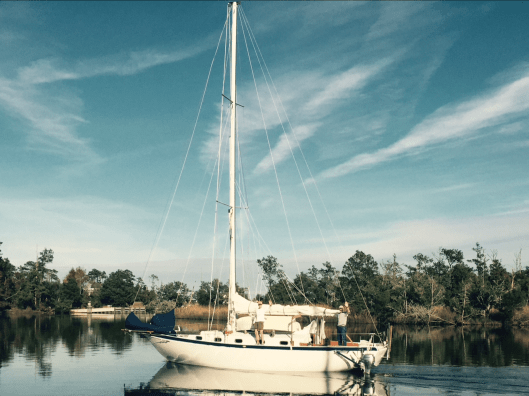
Here we are departing Hancock Marina on 29 Nov 2015 for the BVI.  There was not a breath of air.  We used the engine to get to the head of Adams Creek on the ICW that afternoon.  The next day we sailed all the way down the ICW, under two bridges, and out to Cape Lookout where we waited for a weather window to cross the Gulf Stream. A few days later a friend linked up with us in the Bight at Cape Lookout and we transferred the engine to his skiff.  We sailed to the BVI engine free.

While I would prefer to have the Far Reach engine free all the time it would require access to a mooring that we could sail on and off. There are very few moorings in NC and none where we are. She is berthed in a small marina with 360° of protection. So, we often carry a Honda 9.9hp four stroke outboard on a custom-made removable swing arm bracket attached to the port quarter. The outboard allows us to more conveniently move her in and out of her slip, make the tight turn onto the fairway, then exit the narrow 1/4 mile long channel out to the Neuse River.
Continue reading →

Crank Up the Heat: An Efficient Heater Extends Your Sailing Season.

16 Saturday Dec 2017

Posted by farreachvoyages in Equipment, Modifications, Voyaging

≈ Leave a comment

6E21C494-E341-4CFD-A9FD-2FAC48D92497

Not only is an efficient heater a wonderful luxury, it greatly extends the sailing season.

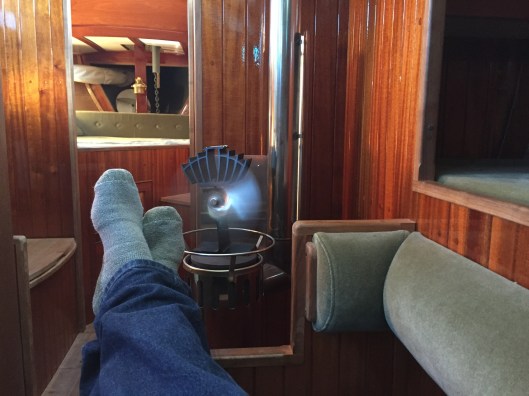
It was about 40° F when I got to the boat the other day. Had a few small projects to accomplish and I needed to complete some reading for a college seminar I teach one night per week.  When we rebuilt the Far Reach we installed a small Danish designed gravity drip heater called a Refleks M66MK.  It is normally set up for diesel fuel but since we don’t have an inboard engine we jetted  it for slightly more efficient kerosene.  The combusted fuel is vented out of the boat via the flue and a Refleks smoke-head.

The fan on the heater top is called an Eco Fan. It runs through a process called the pelitier effect which is the result of the second law of thermodynamics—heat flows from an object at a higher tempature to a body at a cooler temperature.  The fan sits on the cast iron heater top-plate.  The fan base absorbs heat which in turn moves towards the cooling fans.  In the process, the heat passes over a thermocouple.  As as a result, a small amount of electricity powers a 12 volt fan located in the fan body, which drives the fan blade.  The fan does a wounderful job of moving the warm air around the boat.  It can also be repositioned to blow the heat in any direction desired.


36DDACA8-67A8-46EE-95EC-ABED33DF1434

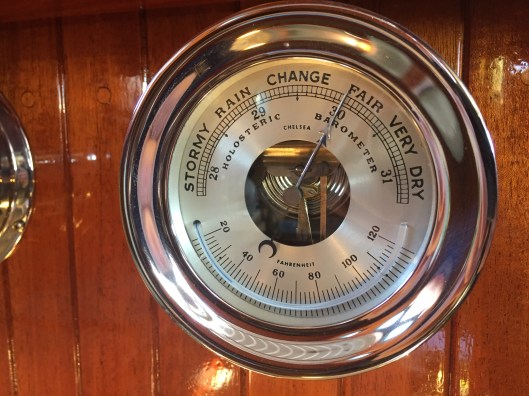
When I arrived at the boat it was 42° F.

In no time the boat was toasty warm. The Refleks Heater Has settings from 1-8.  We had it on level 1 or 2 … so it’s very efficient.

8980A401-10BF-496F-B249-456C3502314B

It took maybe 40 minutes to get the temp up to 72° F.

The boat is wonderfully comfortable and quiet.  Like a well made tiny house but ready to go to sea and serve as our magic carpet to any place we may desire.

Another Stays’l Modification—Brass Luff Rings

10 Sunday Dec 2017

Posted by farreachvoyages in Modifications, Sails, Techniques, Tactics, Tips, Upgrades

≈ 2 Comments

BA2AA89D-00E4-4A78-89FF-1C8A566D6061

I replaced the heavy and clumsy brass piston hanks on the stays’l with traditional brass luff rings.

We use SS 7×7 5/16” wire rope for all the standing rigging on the Far Reach, except the forestay. For the forestay, we use synthetic 9mm Dynex Dux (heat treated dyneema). Recently, we modified the forestay to make it easy to detach it from the gammon iron. That modification allows us to open up the foretriangle making it easier to short tack as the forestay is no longer an obstruction to the jib. The modification, includes a partially covered dyneema that serves as a lanyard, and a few low-friction rings.

Continue reading →

A Reefing Jib With A Zippered Bonnet

04 Monday Dec 2017

Posted by farreachvoyages in Modifications, Repairs, Sails, Techniques, Tactics, Tips, Upgrades

≈ Leave a comment

D51CFB36-0E45-4D61-A31A-2BAEB4CCEC8E

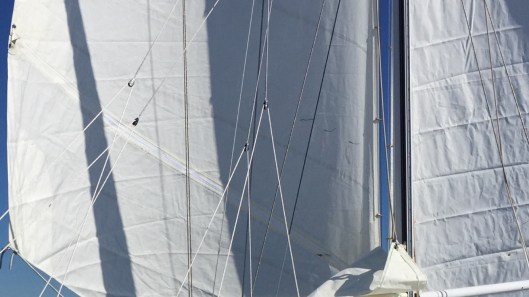
On the left is the genoa with the zippered bonnet.   At the upper left of the photo you can see the working jib clew cringle and just below it the leather cover that protects the zipper.  You can clearly see the zipper running diagonally down from left to right. You might also notice there’s is no cover for the majority of the zipper.  It seems to handle the loads just fine.

I have been asked about our bonneted jib a number of times.  I was asked about it again the other day on the Cape Dory forum.  So, it seemed like a good time to provide more detail to those who might be interested.

Continue reading →

Refining the Jib Downhaul System

02 Saturday Dec 2017

Posted by farreachvoyages in Modifications, Sails, Techniques, Tactics, Tips, Upgrades

≈ 2 Comments

9788AE71-B0C5-4D91-9169-FE224C6B3881

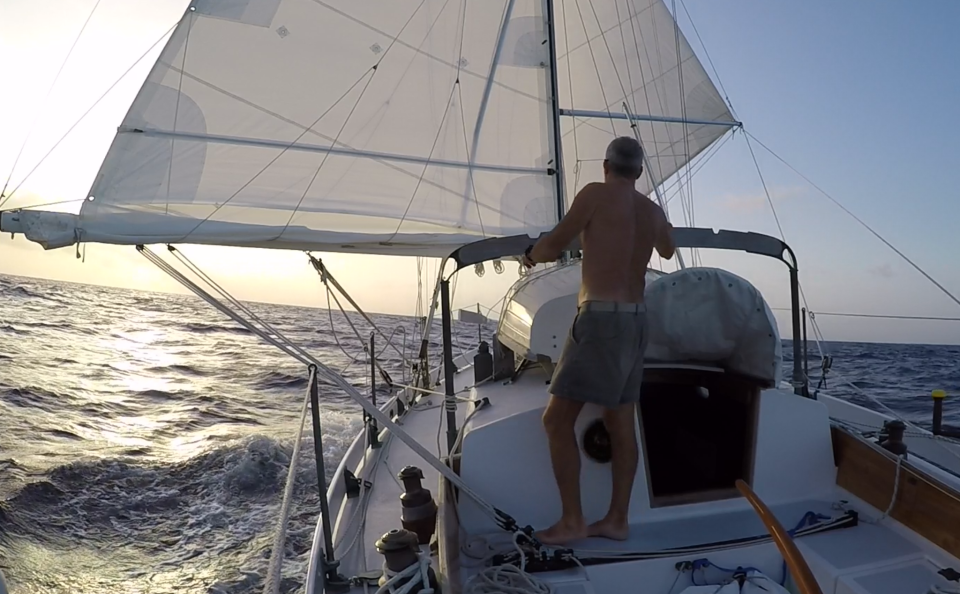
On passage, with a double reefed main and a stays’l.  About 150 nm SSE of Bermuda enroute to the BVI, Dec 2015.  The downhaul keeps the head of the sail secured to the deck yet the halyard remains connected to the jib and ready to be hoisted in an instant.  The coiled downhaul is tied to the lifeline.  Photo by Tricia Stone

I like sailing with a hank-on jib. A hank-on jib is more efficient and longer lived than a furling headsail. It is less expensive. There is less maintenance required and it is more reliable. But it is not as convienent as a furling jib…no doubt about it. While there are techniques for managing a hank on jib that are tried and proven, it does take skill, occasional acrobatics, and some planning to keep things under control. Our genoa is about 390 sqft. But, it has a bonnet that we can zip off that reduces it to a working jib size of about 280 sqft. But, the challenges are similar with either headsail.

Continue reading →

Archives

Categories

Archives

Blog at WordPress.com.

  • Subscribe Subscribed
    • Far Reach Voyages
    • Join 57 other subscribers
    • Already have a WordPress.com account? Log in now.
    • Far Reach Voyages
    • Subscribe Subscribed
    • Sign up
    • Log in
    • Report this content
    • View site in Reader
    • Manage subscriptions
    • Collapse this bar

Loading Comments...