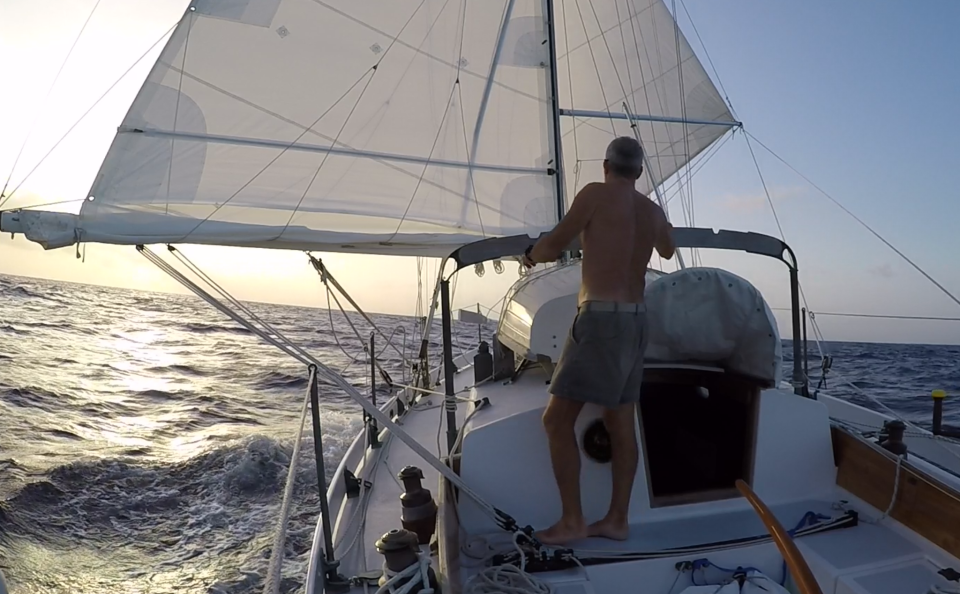

I originally installed the small, but adequate, Lewmar #10, non self tailing, winches as stays’l sheet winches because I had them on hand and it helped keep us on budget. You can see one here just forward of the #44 primary winch.
When I rebuilt the Far Reach, paramount to the effort was staying on budget. It was not easy. I had to determine a way to make hard choices. One thing I decided was to make use of what I already had if it was reasonably serviceable and relatively easy to replace or upgrade later. Winches fell into that category.
The original two speed ST Lewmar 44s were in bad shape. Though powerful, they were a poor design that mixed bronze and aluminum–there was some ugly galvanic corrosion. But they were ridiculously expensive to replace. I could not work around the cost as I was also building a new rig. So I rebuilt them best as I could and pressed on.
When I rebuilt the boat I also redesigned the stays’l layout and eliminated the club-footed boom. I installed bronze sheet fairleads on the side deck and installed small (using what I had on hand) #10 single speed non-self-tailing sheet winches on each coaming forward of the #44 primary winches. The design really proved itself on the trip to and from the West Indies but the small winches were barely adequate.
This past year, I set aside some money every month and during the summer I purchased four new bronze Lewmar Ocean Series self-tailing winches that were on sale. I bought two bronze #46 two speed ST winches to replace the old 44s. And, I bought two bronze #16s to replace the #10 stays’l winches.

Though I did not install them this this time, the new #46s will replace the #44 primary winches during Phase II. Because I now use a foot/turning block for the jib sheet, I’ll replace the two inch tall teak pad with a one inch tall pad. That plus the lower profile of the ocean series winch will significantly lower the height of the top of the winch
The #46s have a different bolt pattern than the #44s. I’ll need to build new teak bases for them this winter. But the 16s have the same pattern as the 10s, so installing them is a simpler job. I decided now was a good time to install them.
The first order of business required minor disassembly of the overhead and some cabinetry to get to the nuts on the underside of the deck. This was possible because I designed the new interior to be removable. It took about 30-40 minutes.

Getting to the nuts was easy. Removing the 9″ long bolts was more difficult.
The second order of business was to remove the nearly nine inch long, 1/4″, silicon bronze bolts that secured the winches. This was not a simple matter as I had used plenty of polysulfied bedding compound and butyl tape when I installed them several years ago. But, after a day of trying various techniques I managed to get the bolts out intact and without damage.

Third, I cleaned the bolts at home in the shop and polished them up with a buffing wheel so they would more easily slide back down the long holes through the 2″ tall bare teak rider pad, the 4 1/2″ tall base, the 7/8″ thick deck and the 1/4″ G10 backing plate.
I used a 12″ long 1/4″ drill bit to clean out the holes. I re-chamfered the holes in the teak riser pads to help drive bedding compound around the bolt shafts below the surface of the winch base when I tightened the nuts. Then I test fit the bases and taped them off. I removed the winches and positioned the bolts through the holes. I wiped the winch base and the teak pad down with acetone to remove residual oil and grease. I used butyl tape to make small donuts around the bolts just under the winch base. I applied the polysulfied and installed the winches one at a time. My daughter Cailin used a large screw driver to hold the fasteners in place while I tightened the nuts below deck with a deep socket wrench. We cleaned up the squeeze out, removed the tape, and reinstalled the drums. They looked great. They are more powerful than the #10s and also they are be self-tailing.
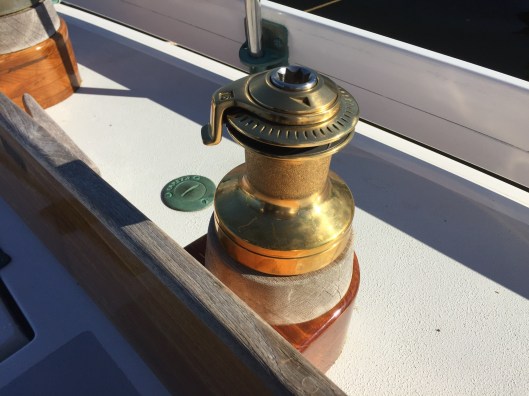
The bronze Ocean Series appear to be very nice winches. They require no tools to disassemble for cleaning. These are the model BBB which has bronze covers over the ST jaws vice the polymer covers which can degrade in the sun.
I look forward to using them and seeing how they work. Replacing the primaries is Phase II and replacing the jib and main halyard winches is Phase III.
 Far Reach Voyages